

Climbing the Second Mountain
Step 1: How do I define a great life?

In The Second Mountain, David Brooks argues that most of us start life climbing what he calls the First Mountain, focused on achievement, status, independence, and success. In midlife, many of us descend into a valley through a mix of restlessness, burnout, loss, or failure. For some, that valley becomes the inspiration that leads them to climb a Second Mountain, one shaped by meaning, service, belonging, and purpose.
This next season of Dear Sam is about my own climb up that second mountain: the struggles along the way, the experiments I’m trying, and the insights I’m discovering as I go.
If you’re new to this Substack, you might be confused. “Isn’t this guy about early retirement, not mountain climbing?”
It’s OK. We’re all confused.
Onwards!

Years ago, I read What Should I Do with My Life?, and one chapter really stuck with me. It tells the story of a man whose people’s ancestral lands were going to be flooded by a proposed new dam. He realised that survival would require more than traditional knowledge alone, so he committed himself to a 100-year plan to educate the Athabascan people in the “white man’s tools” of law and science.
A 100. Year. Plan.
As I’ve confessed before, as nerdy as I am about lists and setting goals, I’ve struggled to articulate a personal vision. Having a 100-year plan is…incomprehensible.
Of course, there are plenty of frameworks to help create a personal vision. The problem is that they all demand sustained, deep thinking, which makes them very easy to put off.
So I had an idea.
What if I used ChatGPT as my anti-procrastination device? My accountability partner? My “vision” shaman? What if I picked a framework and asked it to walk me through it step-by-step, eating the elephant one bite at a time?
I decided to trial this idea using a 7-step process called Strategize Your Life, which takes a standard business strategy framework and reworks it to “help individuals design better futures for themselves”. It looks like this:
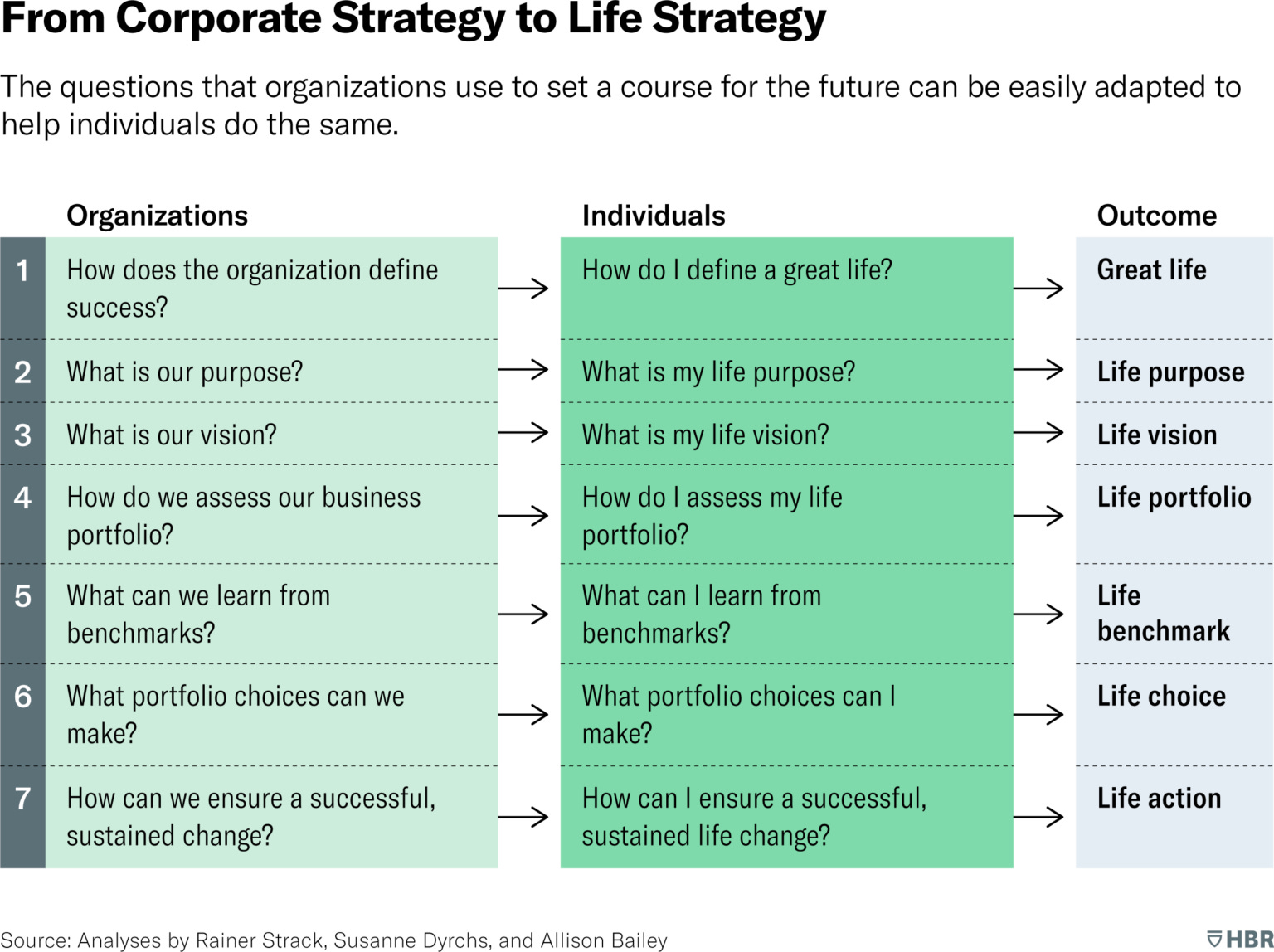
My process was simple:
I uploaded the Strategize Your Life framework to ChatGPT1, and asked it to walk me through it: “I’d like you to help me walk through the strategy process as outlined in the attached article. Let’s go through this step-by-step.”
For each step, I either used Flow to dictate my top-of-mind answers or I copy/pasted prior work I’d already done (often in the form of half-finished notes scattered across UpNote).
Occasionally, I’d ask ChatGPT to summarise my input. Sometimes I’d get it to help me to go a bit deeper, or do a bit of research to challenge or expand what I was thinking.
Before I knew it, I’d finished the 7-step process. I had a life strategy, baby!
Let me walk you through it. Dare you to follow along—one step a week for the next seven weeks. Grab the article, use the same prompts, get a life strategy.
You should do it.
Do it.
Go on.
Then message me with what you came up with. It’ll be like a support group.
Step 1: How do I define a great life?
No horsing the fuck around here, kids! Step 1 dives right in the deep end. 😬
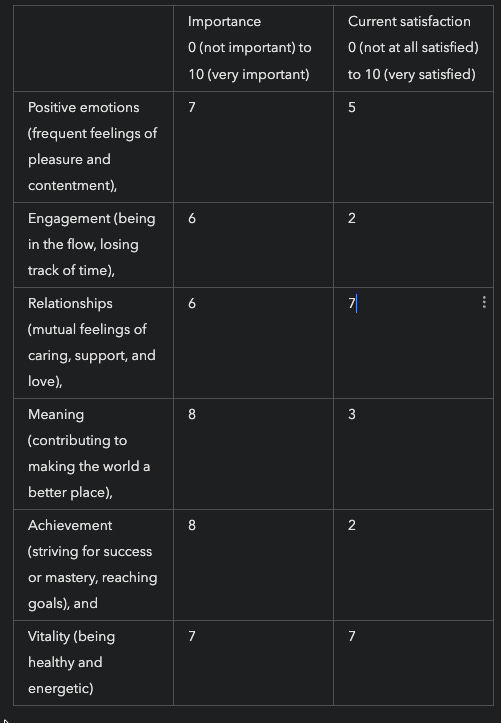
Thankfully, the authors provide a shortcut to defining a great life by suggesting you rate the importance (0-10) and your current level of satisfaction (0-10) across six attributes:
Positive emotions - frequent feelings of pleasure and contentment
Engagement - being in the flow, losing track of time
Relationships - mutual feelings of caring, support, and love
Meaning - contributing to making the world a better place
Achievement - striving for success or mastery, reaching goals
Vitality - being healthy and energetic2
Here are my scores:
ChatGPT then threw in the extra-for-experts question from the article, “Think of 2–3 times you felt deeply satisfied recently — what triggered it?” to which I answered:
“I felt deeply satisfied when we delivered the Samoan Business Hub work. It was a complex project and I worked hard, I worked well, and my hope is that it makes a meaningful difference to our client. I also felt deeply satisfied when completing the Whaka50 mountain bike race. It was months of training. I set myself a goal of getting under four hours, which I did. My race plan went pretty well apart from cramping. It was deeply satisfying to finish that race.”
Step 1, done. Next week, we’ll move on to Step 2: What is my life purpose?
ChatGPT had issues accessing the article via the original URL, so I uploaded a PDF version instead.
This PERMA-V model is based on work originally done by the well-known psychologist Martin Seligman.
Thanx, this is valuable right now
This was an awesome read Trent!
Great penmanship as always!
Would love a copy of the links you mentioned, if you have em’ handy?